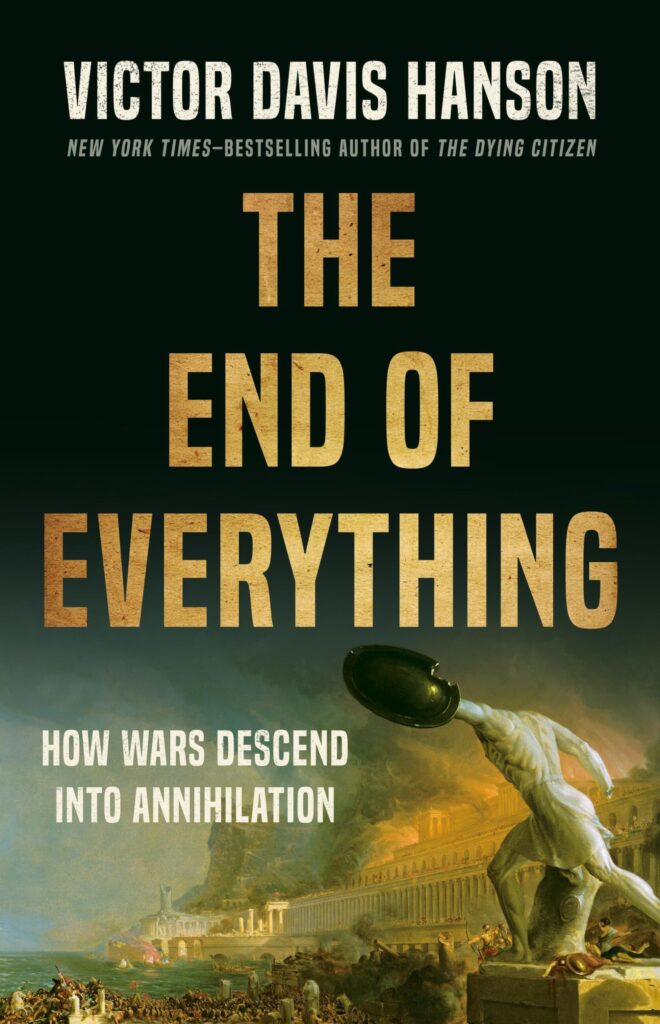
«A New York Times –bestselling historian charts how and why societies from ancient Greece to the modern era chose to utterly destroy their foes, and warns that similar wars of obliteration are possible in our time
War can settle disputes, topple tyrants, and bend the trajectory of civilization—sometimes to the breaking point. From Troy to Hiroshima, moments when war has ended in utter annihilation have reverberated through the centuries, signaling the end of political systems, cultures, and epochs. Though much has changed over the millennia, human nature remains the same. Modern societies are not immune from the horror of a war of extinction.
In The End of Everything , military historian Victor Davis Hanson narrates a series of sieges and sackings that span the age of antiquity to the conquest of the New World to show how societies descend into barbarism and obliteration. In the stories of Thebes, Carthage, Constantinople, and Tenochtitlan, he depicts war’s drama, violence, and folly. Highlighting the naivete that plagued the vanquished and the wrath that justified mass slaughter, Hanson delivers a sobering call to contemporary readers to heed the lessons of obliteration lest we blunder into catastrophe once again.»

The Roman Republic was one of the most remarkable achievements in the history of civilization. After its founding in 509 BCE, Rome grew from an . . .
The Long Twentieth Century traces the relationship between capital accumulation and state formation over a 700-year period. Arrighi argues that capitalism has unfolded as a succession . . .
Varje dag översköljs vi av samma budskap: vi är på väg åt fel håll. Det handlar om finansiella krascher, migrationskriser, arbetslöshet, hungersnöd, krig och miljökatastrofer. . . .
James Gleick, the author of the best sellers Chaos and Genius, now brings us a work just as astonishing and masterly: a revelatory chronicle and meditation that shows . . .
A dramatically new understanding of human history, challenging our most fundamental assumptions about social evolution—from the development of agriculture and cities to the origins of . . .
Marxist drivel. Go and fuck yourself Kennedy.
Nilen renner gjennom tre klimasoner og elleve land med til sammen mer enn tusen folkeslag og snart en halv milliard mennesker. I denne boken fortelles . . .
A sweeping account of the social and political world of the Roman emperors by “the world’s most famous classicist” ( Guardian ). In her international . . .
Terje Tvedt er en fornuftens stemme i en forvirret tid. I Norske tenkemåter. Tekster 2016-2024 blir samtidens dominerende perspektiver endevendt og maktens tenkemåter avdekket.Tvedt viser . . .
Pax is the third in a trilogy of books narrating the history of the Roman Empire. The series that began with Rubicon, and continued with . . .
In the fifth century B.C., a global superpower was determined to bring truth and order to what it regarded as two terrorist states. The superpower . . .
I Historiens hjul og vannets makt utfordrer Terje Tvedt rådende fortolkninger av et av verdenshistoriens mest betydningsfulle spørsmål – den moderne verdens fremvekst og den . . .
For oss nordmenn er vann en selvsagt ting. Så enkelt er det ikke for alle, i andre deler av verden. I dette første programmet tar . . .
I dette programmet skal vi se på vannveienes betydning for bydannelse, transport og handel. Demninger og kanaler innebærer kontroll over elvene. Vi skal ta seerne . . .
Hvorfor er det vann som forener barnet med Gud? Hvorfor brenner likbålene ved bredden av Ganges i India? Hvorfor drar millioner av syke mennesker til . . .
Vann forurenses og overutnyttes. Hvem skal få rent drikkevann? Tilgangen på rent vann vil avgjøre velferdsutviklingen og livsstandarden. Framtidas kriger kan bli en kamp om . . .