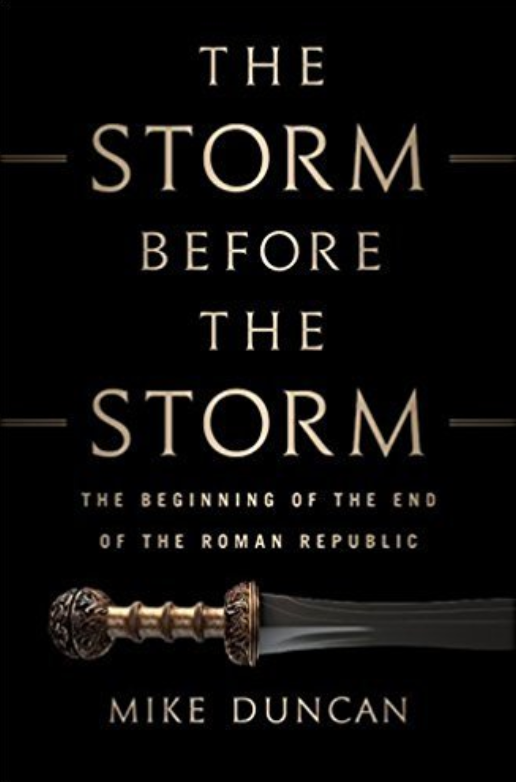
The Roman Republic was one of the most remarkable achievements in the history of civilization. After its founding in 509 BCE, Rome grew from an unremarkable Italian city-state to the dominant superpower of the Mediterranean world. Through it all, the Romans never allowed a single man to seize control of the state. Every year for four hundred years the annually elected consuls voluntarily handed power to their successors. Not once did a consul give in to the temptation to grab absolute power and refuse to let it go. It was a run of political self-denial unmatched in the history of the world. The disciplined Roman republicans then proceeded to explode out of Italy and conquer a world filled with petty tyrants, barbarian chieftains, and despotic kings.
But the very success of the Republic proved to be its undoing. The republican system was unable to cope with the vast empire Rome ruled. Bankrolled by mountains of imperial wealth and without a foreign enemy to keep them united, ambitious Roman leaders began to stray from the republican austerity of their ancestors. Almost as soon as they had conquered the Mediterranean, Rome would become engulfed in violent political conflicts and civil wars that would destroy the Republic less than a century later.
The Storm Before the Storm tells the story of the beginning of the end of the Roman Republic–the story of the first generation that had to cope with the dangerous new political environment made possible by Rome’s unrivaled domination over the known world. The tumultuous years from 133-80 BCE set the stage for the fall of the Republic.
The Republic faced issues like rising economic inequality, increasing political polarization, the privatization of the military, endemic social and ethnic prejudice, rampant corruption, ongoing military quagmires, and the ruthless ambition and unwillingness of elites to do anything to reform the system in time to save it–a situation that draws many parallels to present-day America. These issues are among the reasons why the Roman Republic would fall. And as we all know, those who do not learn from history are doomed to repeat it.
GoodReads
The Long Twentieth Century traces the relationship between capital accumulation and state formation over a 700-year period. Arrighi argues that capitalism has unfolded as a succession . . .
Varje dag översköljs vi av samma budskap: vi är på väg åt fel håll. Det handlar om finansiella krascher, migrationskriser, arbetslöshet, hungersnöd, krig och miljökatastrofer. . . .
James Gleick, the author of the best sellers Chaos and Genius, now brings us a work just as astonishing and masterly: a revelatory chronicle and meditation that shows . . .
«A New York Times –bestselling historian charts how and why societies from ancient Greece to the modern era chose to utterly destroy their foes, and . . .
A dramatically new understanding of human history, challenging our most fundamental assumptions about social evolution—from the development of agriculture and cities to the origins of . . .
Marxist drivel. Go and fuck yourself Kennedy.
Nilen renner gjennom tre klimasoner og elleve land med til sammen mer enn tusen folkeslag og snart en halv milliard mennesker. I denne boken fortelles . . .
A sweeping account of the social and political world of the Roman emperors by “the world’s most famous classicist” ( Guardian ). In her international . . .
Terje Tvedt er en fornuftens stemme i en forvirret tid. I Norske tenkemåter. Tekster 2016-2024 blir samtidens dominerende perspektiver endevendt og maktens tenkemåter avdekket.Tvedt viser . . .
Pax is the third in a trilogy of books narrating the history of the Roman Empire. The series that began with Rubicon, and continued with . . .
In the fifth century B.C., a global superpower was determined to bring truth and order to what it regarded as two terrorist states. The superpower . . .
I Historiens hjul og vannets makt utfordrer Terje Tvedt rådende fortolkninger av et av verdenshistoriens mest betydningsfulle spørsmål – den moderne verdens fremvekst og den . . .
For oss nordmenn er vann en selvsagt ting. Så enkelt er det ikke for alle, i andre deler av verden. I dette første programmet tar . . .
I dette programmet skal vi se på vannveienes betydning for bydannelse, transport og handel. Demninger og kanaler innebærer kontroll over elvene. Vi skal ta seerne . . .
Hvorfor er det vann som forener barnet med Gud? Hvorfor brenner likbålene ved bredden av Ganges i India? Hvorfor drar millioner av syke mennesker til . . .
Vann forurenses og overutnyttes. Hvem skal få rent drikkevann? Tilgangen på rent vann vil avgjøre velferdsutviklingen og livsstandarden. Framtidas kriger kan bli en kamp om . . .