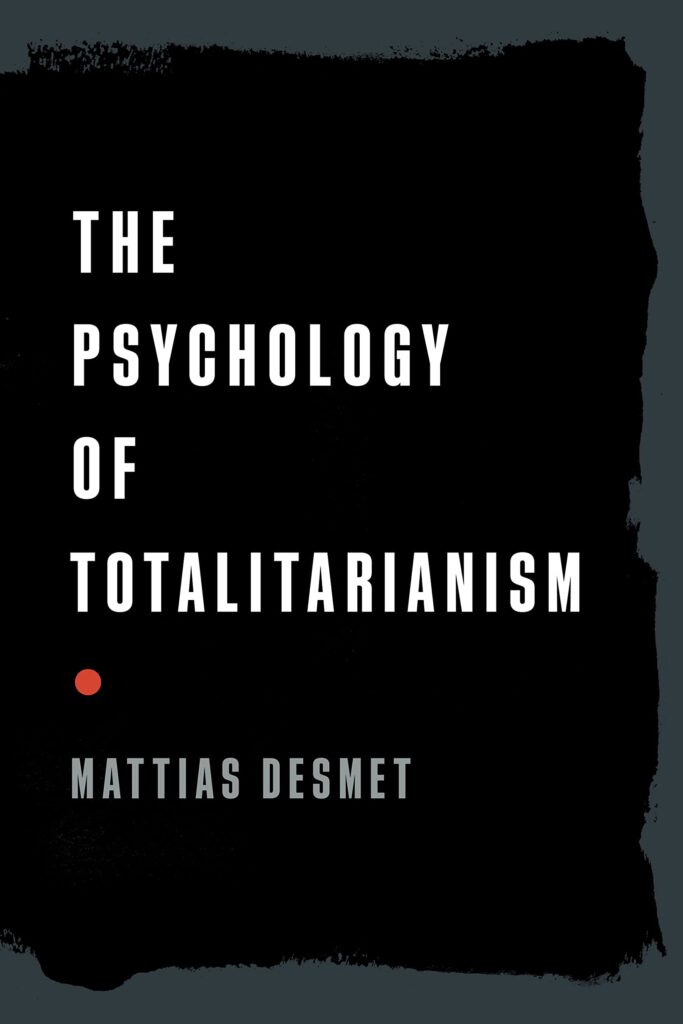
The world is in the grips of mass formation—a dangerous, collective type of hypnosis—as we bear witness to loneliness, free-floating anxiety, and fear giving way to censorship, loss of privacy, and surrendered freedoms. It is all spurred by a singular, focused crisis narrative that forbids dissident views and relies on destructive groupthink.“Alternative voices are stigmatized by a veritable Ministry of Truth, which is crowded with “fact checkers.” Freedom of speech is curtailed by various forms of censorship and self-censorship; people’s right to self-determination is infringed upon by coercive vaccination strategies, which impose heretofore unthinkable social exclusion and segregation upon society.”Desmet’s work on mass formation theory was brought to the world’s attention on The Joe Rogan Experience and in major alternative news outlets around the globe. Read this book to get beyond the sound bites!Totalitarianism is not a coincidence and does not form in a vacuum. It arises from a collective psychosis that has followed a predictable script throughout history, its formation gaining strength and speed with each generation—from the Jacobins to the Nazis and Stalinists—as technology advances. Governments, mass media, and other mechanized forces use fear, loneliness, and isolation to demoralize populations and exert control, persuading large groups of people to act against their own interests, always with destructive results.In The Psychology of Totalitarianism, world-renowned Professor of Clinical Psychology Mattias Desmet deconstructs the societal conditions that allow this collective psychosis to take hold. By looking at our current situation and identifying the phenomenon of “mass formation”—a type of collective hypnosis—he clearly illustrates how close we are to surrendering to totalitarian regimes.With detailed analyses, examples, and results from years of research, Desmet lays out the steps that lead toward mass formation, including:– An overall sense of loneliness and lack of social connections and bonds– A lack of meaning—unsatisfying “bullsh*t jobs” that don’t offer purpose– Free-floating anxiety and discontent that arise from loneliness and lack of meaning– Manifestation of frustration and aggression from anxiety– Emergence of a consistent narrative from government officials, mass media, etc., that exploits and channels frustration and anxietyIn addition to clear psychological analysis—and building on Hannah Arendt’s essential work on totalitarianism, The Origins of Totalitarianism—Desmet offers a sharp critique of the cultural “groupthink” that existed prior to the pandemic and advanced during the COVID crisis. He cautions against the dangers of our current societal landscape, media consumption, and reliance on manipulative technologies and then offers simple solutions—both individual and collective—to prevent the willing sacrifice of our freedoms.“We can honor the right to freedom of expression and the right to self-determination without feeling threatened by each other,” Desmet writes. “But there is a point where we must stop losing ourselves in the crowd to experience meaning and connection. That is the point where the winter of totalitarianism gives way to a spring of life.”
GoodReads
Aren’t we actually sick of sex, of difference, of emancipation, of culture? With this provocative taunt, the indomitable sociologist Jean Baudrillard challenges us to face . . .
Accelerationism is the name of a contemporary political heresy: the insistence that the only radical political response to capitalism is not to protest, disrupt, critique, . . .
The sheer volume and complexity of Deleuze and Guattari’s A Thousand Plateaus can be daunting. What is an assemblage? What is a rhizome? What is . . .
Deleuze is now regarded as the most radical and influential of contemporary philosophers. Here Manuel DeLanda makes sense of Deleuze for both analytic and continental . . .
A User’s Guide to Capitalism and Schizophrenia is a playful and emphatically practical elaboration of the major collaborative work of the French philosophers Gilles Deleuze . . .
Following in the wake of his groundbreaking work War in the Age of Intelligent Machines, Manuel De Landa presents a brilliant, radical synthesis of historical development . . .
From the synchronised camera/machine-guns on the biplanes of World War One to the laser satellites of Star Wars, the technologies of cinema and warfare have . . .
‘Science has never had an advocate quite like David Deutsch … A computational physicist on a par with his touchstones Alan Turing and Richard Feynman, . . .
«‘Watching the president’s Christmas message produces this necropolar, white-mass sensation. Seeing the video broadcast of the Christmas service in the cathedral itself, with these pathetic . . .
Our competitive, service-oriented societies are taking a toll on the late-modern individual. Rather than improving life, multitasking, «user-friendly» technology, and the culture of convenience are . . .
«The future once promised the certainty of a better life for all but now it is full of uncertainty, danger and fear. Our lives are . . .
What is science? Is there a real difference between science and myth? Is science objective? Can science explain everything? This Very Short Introduction provides a . . .
In a provocative analysis written during the unfolding drama of 1992, Baudrillard draws on his concepts of simulation and the hyperreal to argue that the . . .
«Pure war» is the name of the invisible war that technology is waging against humanity. In this dazzling dialogue with Sylvere Lotringer, Paul Virilio for . . .
‘Moralens genealogi’ er boken hvor Nietzsche innfører det berømte skillet mellom herremoral og slavemoral. Slavemoralen fremtrer som misunnelse overfor den som er kreativ og livsdyktig. . . .
The most influential book of the past seventy-five years: a groundbreaking exploration of everything we know about what we don’t know, now with a new . . .
«Kanskje finnes det for latteren ennå en fremtid!», skriver Nietzsche i åpningen av Den muntre vitenskapen. Med satire og skarpe iakttakelser legger han blant annet . . .
Hvorfor gjør vi feil? Og hvorfor i all verden fortsetter vi å gjøre de samme feilene gang på gang? Vi tenker i ett av to . . .
«The planet is sick. Human beings are guilty of damaging it. We have to pay. Today, that is the orthodoxy throughout the Western world. Distrust . . .
Virilio’s exploration of the relationship between technology, war and information technology. “Civilization or the militarization of science?” With this typically hyperbolic and provocative question as . . .