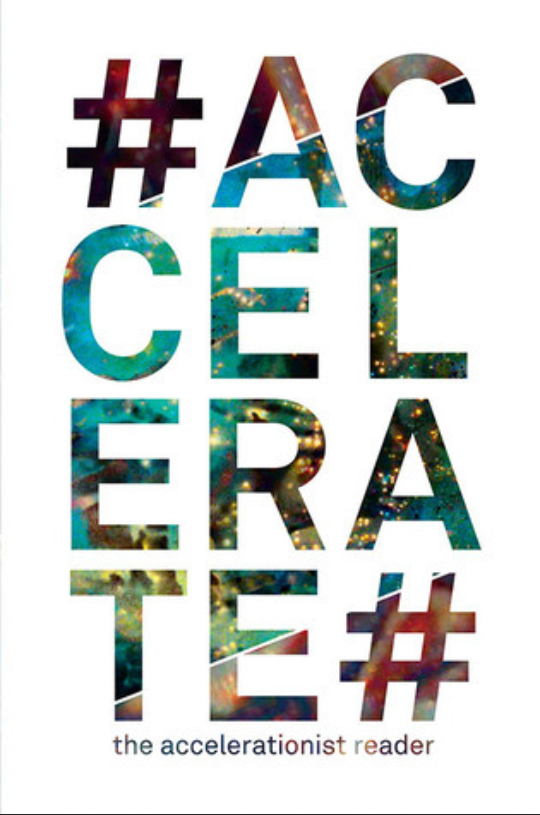
Accelerationism is the name of a contemporary political heresy: the insistence that the only radical political response to capitalism is not to protest, disrupt, critique, or détourne it, but to accelerate and exacerbate its uprooting, alienating, decoding, abstractive tendencies.
The term was coined to designate a certain nihilistic alignment of theory with the excess and abandon of capitalist culture, and the associated performative aesthetic of texts that seek to become immanent to the very process of alienation. Developing at the dawn of contemporary neoliberal consensus, the uneasy status of this impulse, between subversion and acquiescence, between theoretical purchase and aesthetic enjoyment, constitutes the core problematic of accelerationism.
Since the 2013 publication of Williams’s and Srnicek’s #Accelerate: Manifesto for an Accelerationist Politics, the term has been adopted to name a set of new theoretical enterprises that aim to conceptualise non-capitalist futures outside of traditional marxist critiques and regressive, decelerative or restorative solutions.
#ACCELERATE presents a genealogy of accelerationism, tracking the impulse through 90s UK darkside cyberculture and the theory-fictions of Nick Land, Sadie Plant, Iain Grant, and anonymous units like CCRU and SWITCH, across the cultural underground of the 80s (rave, acid house, Terminator and Bladerunner) and back to its sources in delirious post-68 ferment, in texts whose searing nihilistic jouissance would later be disavowed by their authors and the marxist and academic establishment alike.
On either side of this largely unexplored central sequence, the book includes texts by Marx that call attention to his own ‘Prometheanism’ and key works from recent years document the recent extraordinary emergence of new accelerationisms steeled against the onslaughts of neoliberal capitalist realism, and retooled for the twenty-first century.
At the forefront of the energetic contemporary debate around this disputed, problematic term, #ACCELERATE activates a historical conversation about futurality, technology, politics, enjoyment and Kapital. This is a legacy shot through with contradictions, yet urgently galvanized today by the poverty of ‘reasonable’ contemporary political alternatives.
GoodReads
Aren’t we actually sick of sex, of difference, of emancipation, of culture? With this provocative taunt, the indomitable sociologist Jean Baudrillard challenges us to face . . .
The sheer volume and complexity of Deleuze and Guattari’s A Thousand Plateaus can be daunting. What is an assemblage? What is a rhizome? What is . . .
Deleuze is now regarded as the most radical and influential of contemporary philosophers. Here Manuel DeLanda makes sense of Deleuze for both analytic and continental . . .
A User’s Guide to Capitalism and Schizophrenia is a playful and emphatically practical elaboration of the major collaborative work of the French philosophers Gilles Deleuze . . .
Following in the wake of his groundbreaking work War in the Age of Intelligent Machines, Manuel De Landa presents a brilliant, radical synthesis of historical development . . .
From the synchronised camera/machine-guns on the biplanes of World War One to the laser satellites of Star Wars, the technologies of cinema and warfare have . . .
‘Science has never had an advocate quite like David Deutsch … A computational physicist on a par with his touchstones Alan Turing and Richard Feynman, . . .
«‘Watching the president’s Christmas message produces this necropolar, white-mass sensation. Seeing the video broadcast of the Christmas service in the cathedral itself, with these pathetic . . .
Our competitive, service-oriented societies are taking a toll on the late-modern individual. Rather than improving life, multitasking, «user-friendly» technology, and the culture of convenience are . . .
«The future once promised the certainty of a better life for all but now it is full of uncertainty, danger and fear. Our lives are . . .
What is science? Is there a real difference between science and myth? Is science objective? Can science explain everything? This Very Short Introduction provides a . . .
In a provocative analysis written during the unfolding drama of 1992, Baudrillard draws on his concepts of simulation and the hyperreal to argue that the . . .
The world is in the grips of mass formation—a dangerous, collective type of hypnosis—as we bear witness to loneliness, free-floating anxiety, and fear giving way . . .
«Pure war» is the name of the invisible war that technology is waging against humanity. In this dazzling dialogue with Sylvere Lotringer, Paul Virilio for . . .
‘Moralens genealogi’ er boken hvor Nietzsche innfører det berømte skillet mellom herremoral og slavemoral. Slavemoralen fremtrer som misunnelse overfor den som er kreativ og livsdyktig. . . .
The most influential book of the past seventy-five years: a groundbreaking exploration of everything we know about what we don’t know, now with a new . . .
«Kanskje finnes det for latteren ennå en fremtid!», skriver Nietzsche i åpningen av Den muntre vitenskapen. Med satire og skarpe iakttakelser legger han blant annet . . .
Hvorfor gjør vi feil? Og hvorfor i all verden fortsetter vi å gjøre de samme feilene gang på gang? Vi tenker i ett av to . . .
«The planet is sick. Human beings are guilty of damaging it. We have to pay. Today, that is the orthodoxy throughout the Western world. Distrust . . .
Virilio’s exploration of the relationship between technology, war and information technology. “Civilization or the militarization of science?” With this typically hyperbolic and provocative question as . . .