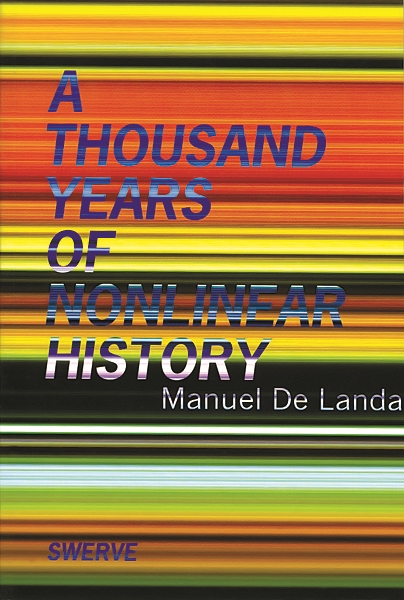
Following in the wake of his groundbreaking work War in the Age of Intelligent Machines, Manuel De Landa presents a brilliant, radical synthesis of historical development of the last thousand years. A Thousand Years of Nonlinear History sketches the outlines of a renewed materialist philosophy of history in the tradition of Fernand Braudel, Gilles Deleuze, and Félix Guattari, while engaging — in an entirely unprecedented manner — the critical new understanding of material processes derived from the sciences of dynamics. Working against prevailing attitudes that see history merely as the arena of texts, discourses, ideologies, and metaphors, De Landa traces the concrete movements and interplays of matter and energy through human populations in the last millennium. The result is an entirely novel approach to the study of human societies and their always mobile, semi-stable forms, cities, economies, technologies, and languages.
De Landa attacks three domains that have given shape to human societies: economics, biology, and linguistics. In each case, De Landa discloses the self-directed processes of matter and energy interacting with the whim and will of human history itself to form a panoramic vision of the West free of rigid teleology and naive notions of progress and, even more important, free of any deterministic source for its urban, institutional, and technological forms. The source of all concrete forms in the West’s history, rather, is shown to derive from internal morphogenetic capabilities that lie within the flow of matter—energy itself.
GoodReads
Aren’t we actually sick of sex, of difference, of emancipation, of culture? With this provocative taunt, the indomitable sociologist Jean Baudrillard challenges us to face . . .
Accelerationism is the name of a contemporary political heresy: the insistence that the only radical political response to capitalism is not to protest, disrupt, critique, . . .
The sheer volume and complexity of Deleuze and Guattari’s A Thousand Plateaus can be daunting. What is an assemblage? What is a rhizome? What is . . .
Deleuze is now regarded as the most radical and influential of contemporary philosophers. Here Manuel DeLanda makes sense of Deleuze for both analytic and continental . . .
A User’s Guide to Capitalism and Schizophrenia is a playful and emphatically practical elaboration of the major collaborative work of the French philosophers Gilles Deleuze . . .
From the synchronised camera/machine-guns on the biplanes of World War One to the laser satellites of Star Wars, the technologies of cinema and warfare have . . .
‘Science has never had an advocate quite like David Deutsch … A computational physicist on a par with his touchstones Alan Turing and Richard Feynman, . . .
«‘Watching the president’s Christmas message produces this necropolar, white-mass sensation. Seeing the video broadcast of the Christmas service in the cathedral itself, with these pathetic . . .
Our competitive, service-oriented societies are taking a toll on the late-modern individual. Rather than improving life, multitasking, «user-friendly» technology, and the culture of convenience are . . .
«The future once promised the certainty of a better life for all but now it is full of uncertainty, danger and fear. Our lives are . . .
What is science? Is there a real difference between science and myth? Is science objective? Can science explain everything? This Very Short Introduction provides a . . .
In a provocative analysis written during the unfolding drama of 1992, Baudrillard draws on his concepts of simulation and the hyperreal to argue that the . . .
The world is in the grips of mass formation—a dangerous, collective type of hypnosis—as we bear witness to loneliness, free-floating anxiety, and fear giving way . . .
«Pure war» is the name of the invisible war that technology is waging against humanity. In this dazzling dialogue with Sylvere Lotringer, Paul Virilio for . . .
‘Moralens genealogi’ er boken hvor Nietzsche innfører det berømte skillet mellom herremoral og slavemoral. Slavemoralen fremtrer som misunnelse overfor den som er kreativ og livsdyktig. . . .
The most influential book of the past seventy-five years: a groundbreaking exploration of everything we know about what we don’t know, now with a new . . .
«Kanskje finnes det for latteren ennå en fremtid!», skriver Nietzsche i åpningen av Den muntre vitenskapen. Med satire og skarpe iakttakelser legger han blant annet . . .
Hvorfor gjør vi feil? Og hvorfor i all verden fortsetter vi å gjøre de samme feilene gang på gang? Vi tenker i ett av to . . .
«The planet is sick. Human beings are guilty of damaging it. We have to pay. Today, that is the orthodoxy throughout the Western world. Distrust . . .
Virilio’s exploration of the relationship between technology, war and information technology. “Civilization or the militarization of science?” With this typically hyperbolic and provocative question as . . .