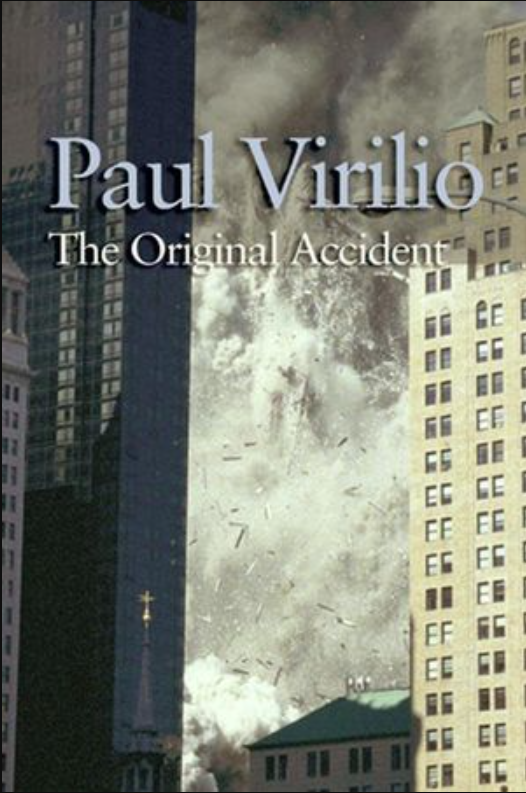
«The future once promised the certainty of a better life for all but now it is full of uncertainty, danger and fear. Our lives are surrounded by the threats, imaginary or real, posed by terrorist outrages, natural catastrophes and disasters of all kinds. The future is overshadowed by the nightmare of an outmoded humanity overwhelmed by a catastrophe of its own making, a kind of catastrophic grand finale that would mirror the original accident – the Big Bang – that some scientists believe created the universe.
A biting meditation on Progress technoscientific progress, at any cost and without any limits this book defines the ways in which postindustrial science has merged with out-and-out hyperterrorism to threaten the foundations of Greco-Roman, Judeo-Christian civilization, and the future of the planet with them, through innovation of mass catastrophes that are part and parcel of its panoply of inventions.
Urging us to face up to the consequences of our brave-new-world technologies, Virilio calls for the creation of a Museum of the Accident to fight our habituation to horror and violence, and our daily overexposure to terror, in the name, not of some preventive war, but of a preventive intelligence that would help us deal with both natural and artificial disasters.»

Aren’t we actually sick of sex, of difference, of emancipation, of culture? With this provocative taunt, the indomitable sociologist Jean Baudrillard challenges us to face . . .
Accelerationism is the name of a contemporary political heresy: the insistence that the only radical political response to capitalism is not to protest, disrupt, critique, . . .
The sheer volume and complexity of Deleuze and Guattari’s A Thousand Plateaus can be daunting. What is an assemblage? What is a rhizome? What is . . .
Deleuze is now regarded as the most radical and influential of contemporary philosophers. Here Manuel DeLanda makes sense of Deleuze for both analytic and continental . . .
A User’s Guide to Capitalism and Schizophrenia is a playful and emphatically practical elaboration of the major collaborative work of the French philosophers Gilles Deleuze . . .
Following in the wake of his groundbreaking work War in the Age of Intelligent Machines, Manuel De Landa presents a brilliant, radical synthesis of historical development . . .
From the synchronised camera/machine-guns on the biplanes of World War One to the laser satellites of Star Wars, the technologies of cinema and warfare have . . .
‘Science has never had an advocate quite like David Deutsch … A computational physicist on a par with his touchstones Alan Turing and Richard Feynman, . . .
«‘Watching the president’s Christmas message produces this necropolar, white-mass sensation. Seeing the video broadcast of the Christmas service in the cathedral itself, with these pathetic . . .
Our competitive, service-oriented societies are taking a toll on the late-modern individual. Rather than improving life, multitasking, «user-friendly» technology, and the culture of convenience are . . .
What is science? Is there a real difference between science and myth? Is science objective? Can science explain everything? This Very Short Introduction provides a . . .
In a provocative analysis written during the unfolding drama of 1992, Baudrillard draws on his concepts of simulation and the hyperreal to argue that the . . .
The world is in the grips of mass formation—a dangerous, collective type of hypnosis—as we bear witness to loneliness, free-floating anxiety, and fear giving way . . .
«Pure war» is the name of the invisible war that technology is waging against humanity. In this dazzling dialogue with Sylvere Lotringer, Paul Virilio for . . .
‘Moralens genealogi’ er boken hvor Nietzsche innfører det berømte skillet mellom herremoral og slavemoral. Slavemoralen fremtrer som misunnelse overfor den som er kreativ og livsdyktig. . . .
The most influential book of the past seventy-five years: a groundbreaking exploration of everything we know about what we don’t know, now with a new . . .
«Kanskje finnes det for latteren ennå en fremtid!», skriver Nietzsche i åpningen av Den muntre vitenskapen. Med satire og skarpe iakttakelser legger han blant annet . . .
Hvorfor gjør vi feil? Og hvorfor i all verden fortsetter vi å gjøre de samme feilene gang på gang? Vi tenker i ett av to . . .
«The planet is sick. Human beings are guilty of damaging it. We have to pay. Today, that is the orthodoxy throughout the Western world. Distrust . . .
Virilio’s exploration of the relationship between technology, war and information technology. “Civilization or the militarization of science?” With this typically hyperbolic and provocative question as . . .